
Softer footstep noise
Floating boards carry the sound of footsteps into the room and to the floor below. A suitable underlay dampens this noticeably, especially in apartment buildings.
Underlay is the thin layer between the base floor and the new boards. It decides whether footsteps sound dull or hollow, whether joints stay tight and how much moisture reaches the plank. Here is how the types differ and where each one belongs.
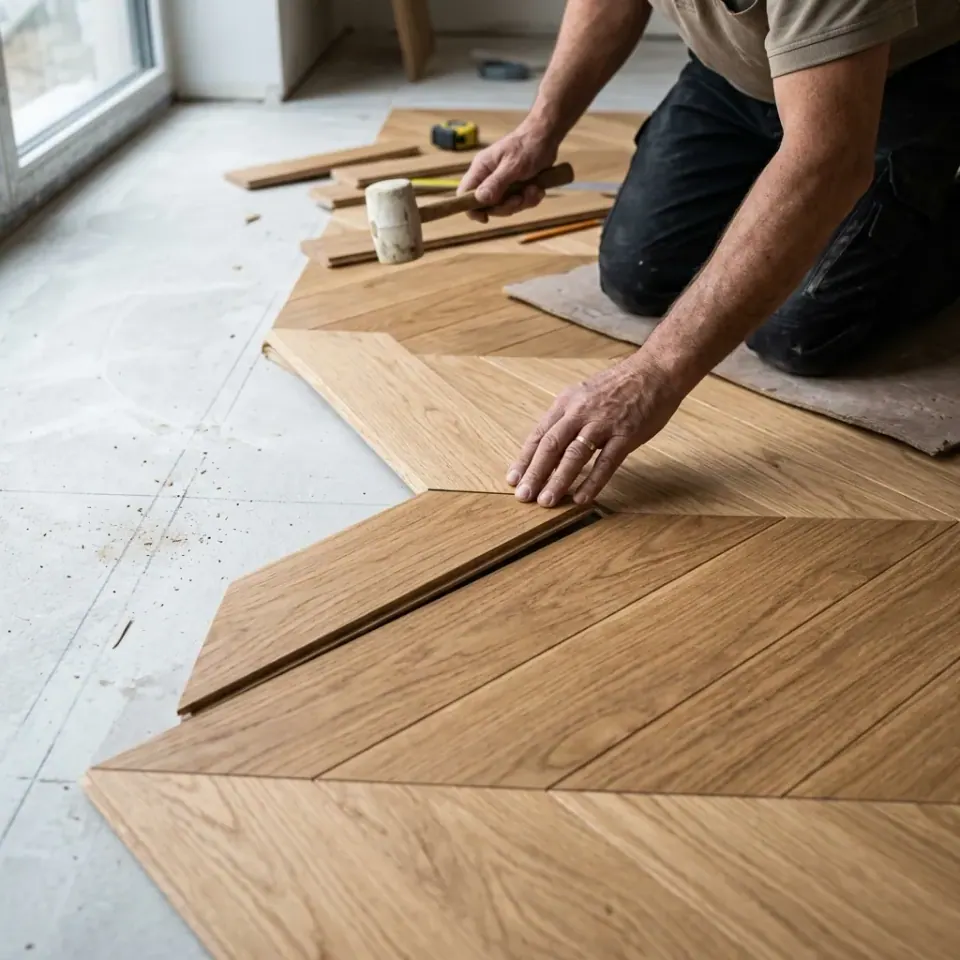
Many people treat it as an optional extra to trim the budget, yet it affects the lifespan of the floor and how it feels underfoot. If you are still comparing parquet with vinyl, remember that both usually need a suitable layer beneath them.
Floating boards carry the sound of footsteps into the room and to the floor below. A suitable underlay dampens this noticeably, especially in apartment buildings.
Concrete holds water vapour for a long time. A polyethylene sheet or purpose-made membrane limits how much reaches a timber parquet plank.
An underlay cannot fix an uneven floor, but it absorbs tiny surface flaws and stops grit or small bumps from telegraphing through the boards.
A resilient layer feels softer and slightly warmer than boards laid straight onto cold tile or concrete.
It reduces friction between the base and the plank and lets the click system work without stress on floating floors.
Many manufacturers require a specific underlay type or forbid a very thick one. Ask us before you buy so you do not void the product guidance.
No single underlay suits every floor. The choice follows the board you are installing, the base floor, whether the building is an upstairs flat or a ground-floor villa, and whether sound or moisture is the main concern.
A light roll commonly laid under floating parquet and laminate. It softens sound a little and gives a smoother surface. Some versions come with a reflective layer or taped overlap that also acts as a vapour barrier. Thickness and density vary by product, so we follow the board manufacturer rather than quoting a generic figure.
A denser natural material used when acoustic and thermal comfort matter more. Over fresh or damp concrete it still needs a separate moisture barrier, and it usually costs more than ordinary foam.
Some SPC vinyl and laminate planks arrive with a backing layer already fixed. In that case we add nothing unless the maker allows it, because two layers can make the floor shift when walked on.
A thin plastic sheet laid with overlaps and taped at the seams, turned up slightly at the walls. It matters more under timber and engineered parquet than under vinyl, and it should follow a moisture test as described in floor preparation and levelling.
Adhesive-fixed vinyl needs a flat, dry base more than a cushioning layer. Thick foam is normally not used because it weakens the bond.
| Best use | Key note | |
|---|---|---|
| Polyethylene foam | Floating parquet and laminate in flats and homes | Check thickness against the click system |
| Cork | Rooms needing more acoustic and thermal comfort | Needs a separate moisture barrier over concrete |
| Moisture membrane | Under timber parquet on concrete bases | Laid with overlaps and taped at seams |
| Attached underlay | Some SPC and laminate planks | Do not add another layer without maker approval |
| None (glue-down) | Adhesive vinyl on a flat dry base | Surface preparation is the real underlay |
Before naming a product we ask a few simple questions, because the answers change the decision completely.
If it is old tile we check flatness and whether the grout lines are sound. If it is new concrete we ask when it was poured, since moisture leaves it for months. Laying vinyl over tile is often possible but never removes the need to check flatness.
An upper floor in an apartment block needs more care for sound than a ground-floor villa, while rooms next to a bathroom, kitchen or entrance need care for moisture. For wet rooms we normally point to waterproof flooring options.
Engineered timber parquet reacts differently from rigid vinyl, both to damp and to the thickness of layer it tolerates. We read the product sheet and follow the manufacturer exactly.
Straightedge for flatness, moisture test, then remove dust and debris.
Overlapped between strips, taped and turned up slightly at the walls.
No overlapping layers; tape the seams where the product requires it.
Leave the expansion gap and trim excess once skirting is fitted.
Staggered rows, then a joint and walk-over check before handover.
One of the most frequent errors is buying the thickest roll in the belief it is superior. Extra thickness can let a floating floor move and strain the click joints until they open over time. The opposite also happens: a cheap underlay that cannot take pressure flattens under heavy furniture.
Remember too that underlay does not cure a slope or wave in the base floor. That is solved by levelling, not by foam.

Enter the room length and width to get the area including your waste allowance, then quote it when you contact us so we can plan underlay together with the boards.
Send photos of the rooms or request a free visit and we will tell you which type suits your base and your boards.
Each product names a type and thickness; request the instruction sheet first.
Overlapped underlay lifts the floor at the joints.
Furniture slows the work and exposes the underlay to tears during laying.
A gap around the walls is needed whatever underlay is used.
Most floating boards do, but some arrive with an attached layer. We read the manufacturer instructions and decide after seeing the floor.
Yes for glue-down vinyl; floating vinyl depends on the plank, as some have a backing layer built in.
No. It only limits vapour. Heavy moisture or leaks must be cured before installation; read our preparation guide.
It softens footstep sound and echo to varying degrees, but it is not full insulation. For sensitive rooms consider soundproof carpet.
We do not recommend it; it loses its resilience and may hold damp or dust.
Underlay is for sound and comfort, the membrane is for moisture. Some products combine both.
Send the area and the base floor type on WhatsApp and we will arrange a visit. Read parquet price factors before comparing offers.

Contact us on WhatsApp or by phone for a free visit and a suggestion that fits your floor.
How floor height affects doors and thresholds before installation.
Which floor feels warmest in a Riyadh winter? We compare carpet, rugs, parquet and vinyl on feel and insulation,…
What does a rug pad do? Felt, rubber and mesh types, how to pick size and thickness, and which pads suit parquet…
How to choose safer flooring for older family members: non-slip surfaces, low thresholds, short pile, warmth and…
Carpet, parquet or vinyl for a home entertainment room.
What decides the time to install carpet, vinyl, parquet or artificial grass? Project…
Carpet or tiles for your Riyadh home? Compare warmth, noise, cleaning, moisture and…