
No slack
Fixed at the nosing and inner corner of each tread so nothing shifts, even on a quick climb.
We fit stair carpet tread by tread, as a centre runner or wall-to-banister cover, and carry it into the landings and hallways. Free measuring visit anywhere in Riyadh, then a clear quote.
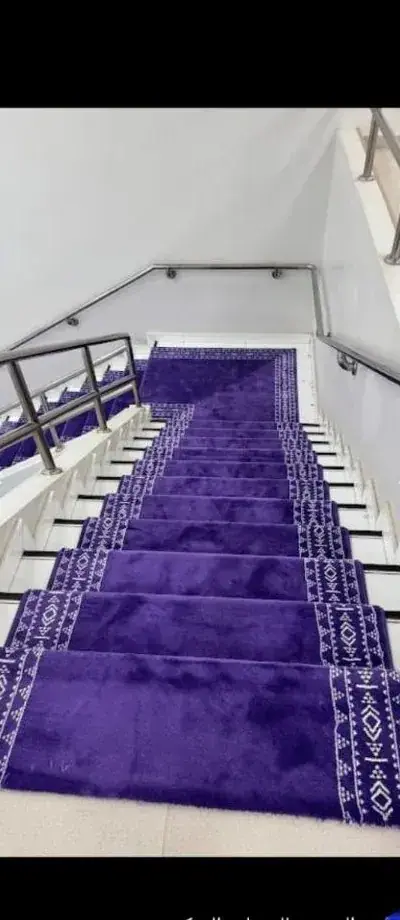
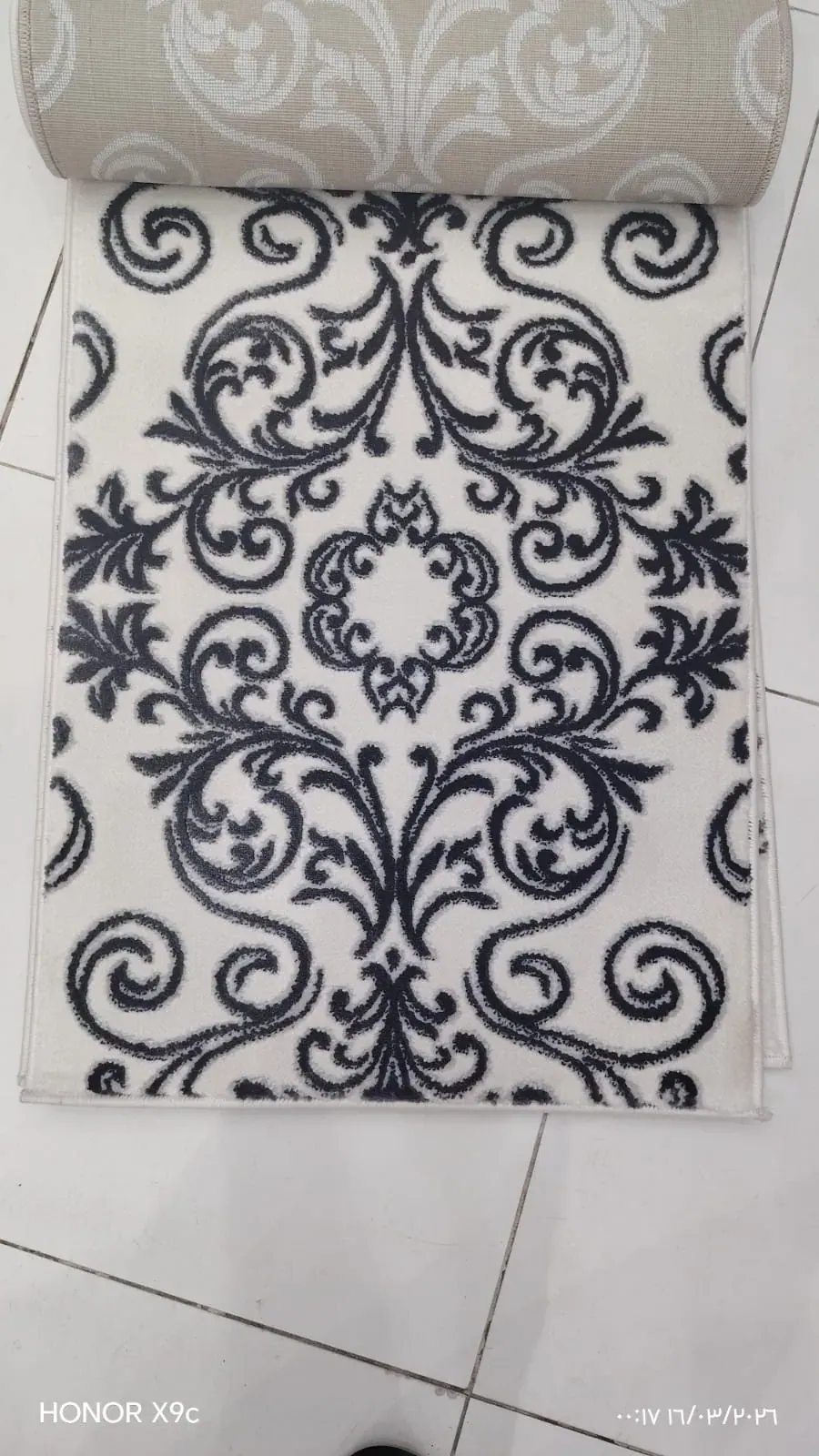
Our carpet and rugs in Riyadh page gives the overview; stairs follow their own rules. Every step puts your full weight on the front edge of the tread, so carpet wears there faster than anywhere else in the house, and any slack becomes a hazard for someone hurrying down.
So we treat a staircase as a series of separate pieces: each tread measured individually, a short dense pile that stays put underfoot, fixed at the nosing and the inner corner. Where the stairs open onto a landing or upstairs lounge, we match the material — see wall-to-wall roll carpet.
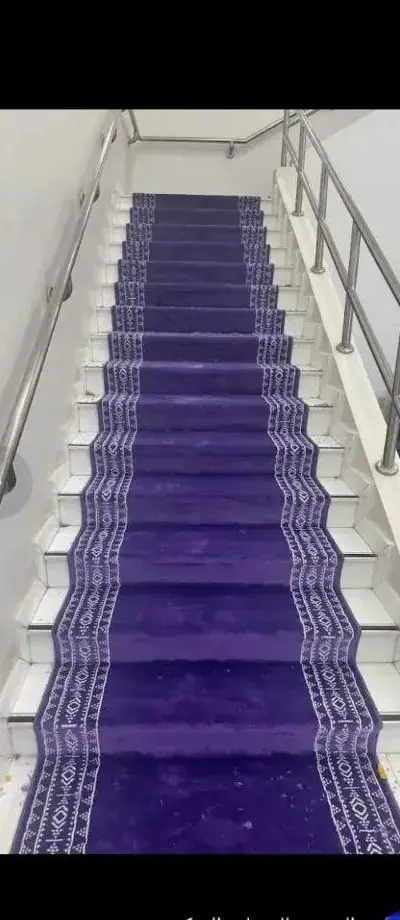
Both are valid; it comes down to how much staircase you want to show and how it is used.
A strip narrower than the tread sits centrally, leaving marble or timber visible either side. Ideal for a handsome staircase you do not want to hide, usually with a bound or decorative edge.
The visible margin must stay equal on both sides on every step, including around turns. For a long hallway in the same design, consider a made-to-measure runner.
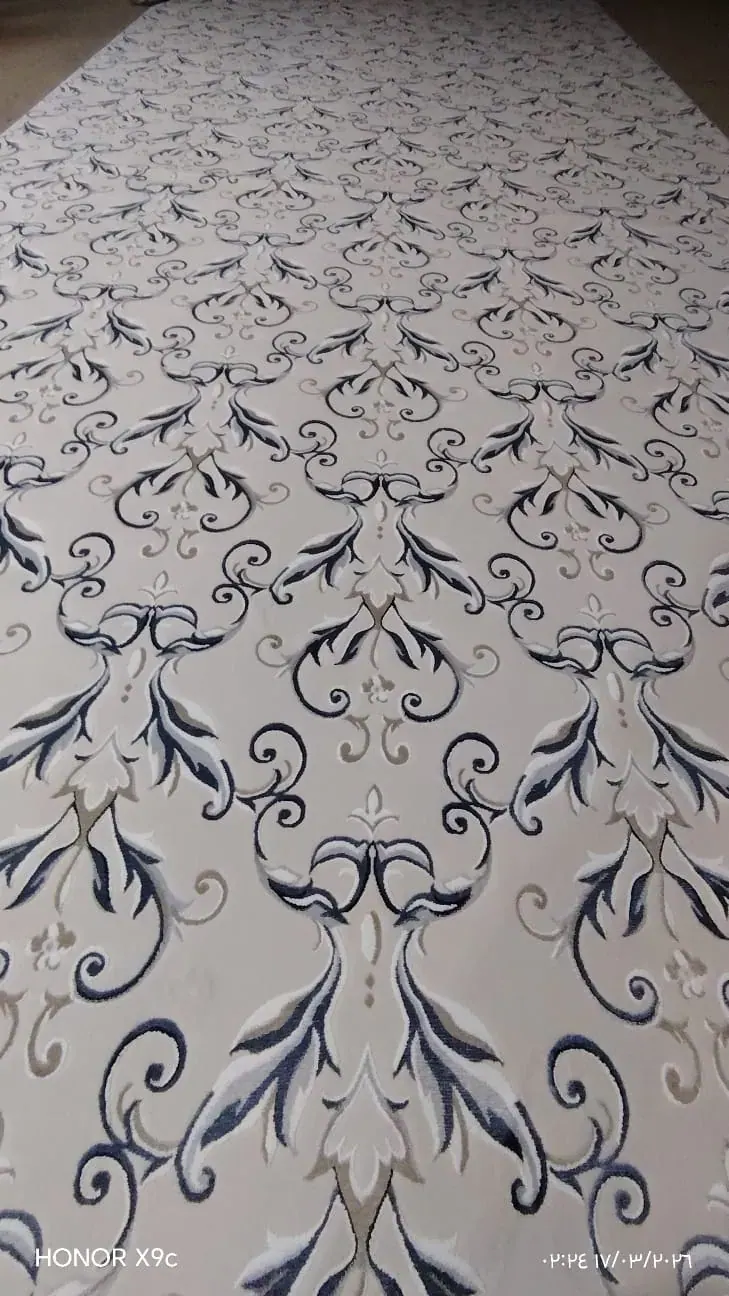
Carpet covers the whole tread, so the stairs read as part of the upstairs hallway. Quieter and warmer, and it hides a tired staircase without renovation.
It demands precise cutting around balusters and along the wall, which is exactly where the quality of a fit shows.

With a waterfall finish the carpet drops straight from the nosing to the tread below — quicker, and fine for thicker piles. A wrapped (Hollywood) finish pulls the carpet tight around the nosing and tucks it under onto the riser, so each step keeps a crisp profile.
Wrapped looks sharper but takes more time and skill. We show you both on the same sample.

Each tread depth and riser height is measured; steps that look identical rarely are.
Carpet wraps the front edge, so its shape and projection add length.
We set the runner width or full-cover edges and equal margins.
Templated individually; length × width is not enough here.
Pile runs downwards and the pattern flows without visible breaks.
| Staircase | Challenge | Our approach |
|---|---|---|
| Straight flight | Simplest, but errors show along the line | Measure each tread, keep margins equal |
| Winders on a turn | Every step is a different shape | A template and separate cut per step |
| Curved or spiral | Edges change along the flight | Usually full cover, or a multi-piece runner |
| Open riser | The underside is visible | Cover the tread only, with a clean underside finish |
| Half landing | A wider area and a change of direction | One piece joined to the runner, no seam on the walking line |
| Marble with bullnose | Smooth stone is hard to fix to | Marble-appropriate fixing and care at the inner corner |
For internal stairs in office buildings, we coordinate with the office carpet tiles on each floor.
Fixed at the nosing and inner corner of each tread so nothing shifts, even on a quick climb.
Thin, firm underlay cut for each step; thick underlay makes the nosing soft and unstable.
Pile pointing to the bottom of the stairs reduces nosing wear and keeps the shade even.
Stripes usually run up the flight; stripes across it can confuse the eye at the edge.
A mid tone or small pattern, plus good lighting, keeps each edge clear for children and older family members.
Short and dense or low loop. Long pile hides the edge and flattens fast.
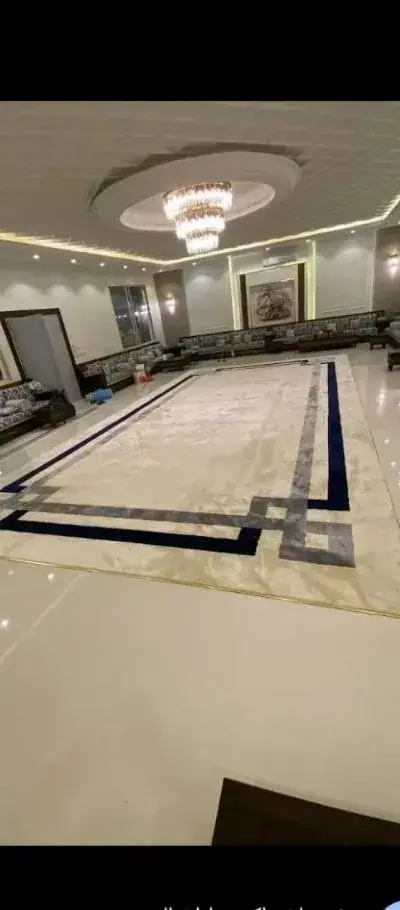
A bordered runner that protects marble and guides traffic.

Internal stairs and corridors in colours that link to the work floors.

Upper-floor stairs and corridors matched to the mosque carpet.
Use it for hallways and landings; the treads themselves we calculate one by one on site.
Not by square metre like a room, but by run: tread depth plus riser height plus the nosing wrap, multiplied by the number of steps, with extra for landings and winders. Two staircases with the same step count can need different amounts. Send a photo and the step count for a first estimate.
There is no single right width. It is usually chosen so an equal strip of stone or wood shows on each side, in proportion to the staircase. Wide villa stairs suit a wider runner; narrow ones often look better fully covered. We test widths on your actual stairs before cutting.
Well fixed, it is less slippery than polished marble and softens falls. The pile should be short and dense, the nosing clearly visible and no edges loose. Check the stairs now and then; if a tread loosens, have it re-tensioned before it gets worse.
We use fixing methods suited to stone, but any installation leaves some trace when removed later, whether adhesive or fixing points. At the visit we explain the method for your stairs and what to expect if the carpet ever comes up.
Vacuum with a hand tool from top to bottom, concentrating on the nosing and inner corner where dust gathers. Blot stains rather than scrubbing, and avoid soaking a tread, as moisture stays in the underlay. Our carpet cleaning guide has more.
Your foot presses and slides on the edge on the way down, so it takes far more friction than the flat tread. A dense pile, pile facing down and firm underlay all slow this, but the nosing is still where a staircase first shows it needs refreshing.
Yes. Upper-floor stairs and prayer-room entrances get concentrated traffic around prayer times. We match the material to the hall carpet and schedule work outside prayers. For smaller rooms inside buildings, see prayer room carpet.


Send photos of the stairs from top and bottom with the step count, and we will book a free visit in Riyadh with runner and full-cover samples.
How to read carpet specifications
Hallway and entrance runner rugs: sizes, materials and how to choose.
Covering stairs with parquet: steps and considerations.
Vinyl for stairs in Riyadh: how to cover steps safely with vinyl, stair nosing and anti-slip strips, curved stairs, installation steps and…
Why mould or a damp smell appears in carpet in Riyadh: AC leaks, wet cleaning, ground floors. When to clean, when to replace and how to prevent it.