
Less echo
Hard surfaces throw sound back into the room. Carpet absorbs part of the mid and high frequencies and gives cleaner recordings, though it does not replace treatment on the walls and ceiling.
A studio floor is chosen for how it behaves, not only how it looks: it shapes echo, carries footstep vibration toward microphones and decides how cleanly cables can run. We supply and install carpet tiles with a suitable underlay after seeing the room and understanding what you record.

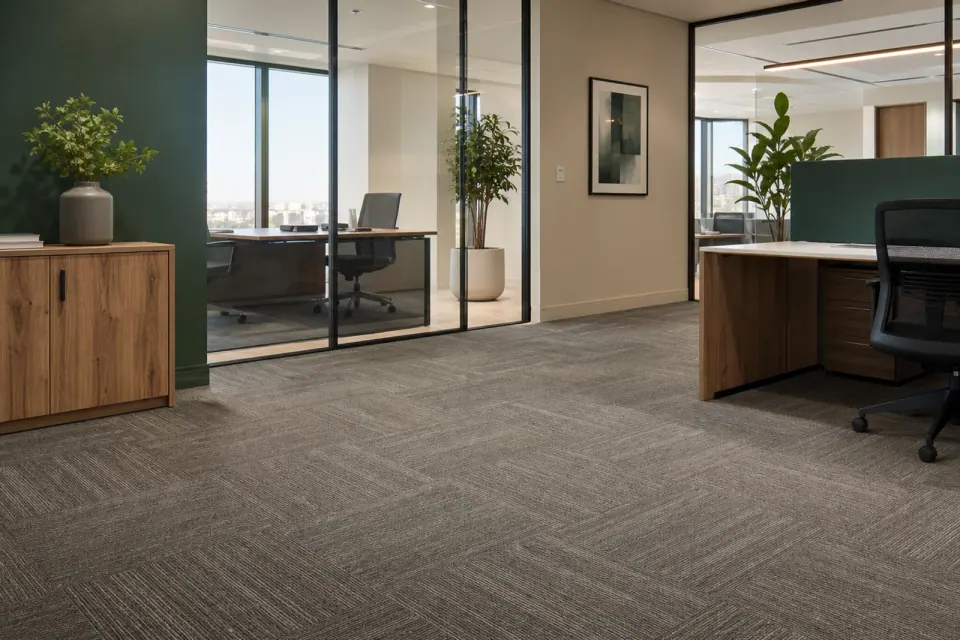
Before choosing a colour we clarify what the room does: vocal booth, two-person podcast or control room with equipment? Each use calls for a different build-up, and these are the points we discuss during the visit.
Hard surfaces throw sound back into the room. Carpet absorbs part of the mid and high frequencies and gives cleaner recordings, though it does not replace treatment on the walls and ceiling.
Footsteps and rolling office chairs send vibration through the floor that can reach a mic stand. A resilient underlay beneath the carpet often reduces that transfer.
Audio and power cables need an orderly path. We plan it before laying so nothing bulges or gets trodden on, and we use suitable trims at doorways.
A floor that moves or creaks ruins takes. We check the slab for flatness and correct differences before installation.
Carpet tiles let you swap a damaged piece without lifting the whole room, which helps a studio with a busy schedule.
Neutral grey or charcoal tones rest the eye and reduce light reflection, keeping attention on the screens and gear.
For many small studios this is the most practical choice. Carpet tiles go down quickly, give access to cables and let you replace one damaged tile, and an underlay can be added depending on the available room height. We also check the finished level so the floor does not clash with door clearances.
Suitable when the room is large and free of complicated cable paths. It gives a continuous look, and we check the seams carefully because a visible join in a recording room can bother the engineer. Material details are on the carpet roll page.
A flexible answer for tenants or temporary spaces, sometimes used only in the recording corner. It should be held with a non-slip base so it never shifts mid-session; see our rug pad guide.
We avoid leaving glossy hard floors alone in recording rooms, and we advise not relying on the floor to block outside noise. Real isolation needs a study of walls, doors and air conditioning. Our part is a suitable floor installed well inside that whole system.
Not every room needs the same material, so we match the solution to what happens in each space.
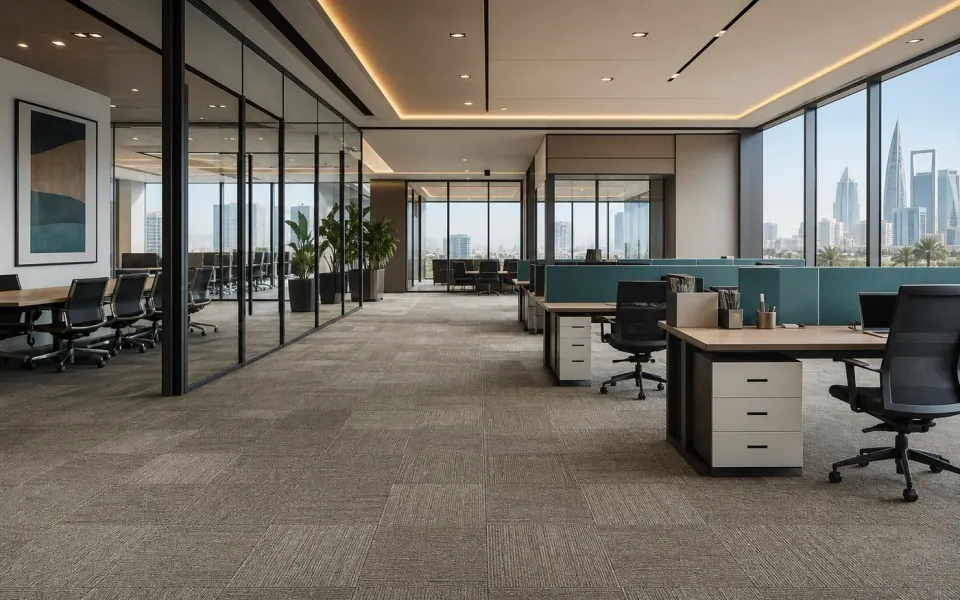
Lots of chair movement and cables, so removable carpet tiles with clear routes work well.

Needs the most calm, so we focus on resilient underlay and as few seams as possible.

Here an elegant, easy-clean vinyl floor works, away from the recording rooms.
We visit the studio and learn the recording type, equipment and cable positions.
We agree the carpet and underlay to suit the height and budget.
We repair cracks, level differences and remove dust before laying.
We lay tiles or roll to respect cable paths and doorways.
We review edges and trims and explain cleaning and care.
| Option | Best for | Note |
|---|---|---|
| Carpet tiles + underlay | Small and medium studios | Easy upkeep and tile swaps; underlay depends on room height |
| Broadloom roll | One large, uniform room | Continuous look but seams need care |
| Thick rug | Recording corner or temporary room | Needs secure fixing and an anti-slip base |
| Hard floor alone | Reception only | We do not recommend it in recording rooms because it adds echo |
Price depends on material, area and the condition of the floor, and we do not quote a figure before the visit. To compare offers, see the flooring quotation comparison guide.
We suggest materials and book a free visit inside Riyadh.
What bothers a studio owner after handover is rarely the carpet itself but the small details: an edge that lifts at the door, a cable lying in the middle of the room, or a creak underfoot. We solve those before laying.
We check the slab using our floor preparation and levelling guide and pick the right trims as covered in the transition strips guide.

We tell you during the visit how long installation should take and when heavy equipment can come in; it depends on the area and the condition of the floor.
Vacuum with suitable suction and treat stains early; see the carpet care guide.
We recommend pads under equipment feet and chair castors made for carpet to limit wear.
If something appears after handover, contact us and we will review it with you clearly.
No, not on its own. Carpet helps reduce echo inside the room, but stopping sound leaking in or out needs treatment of walls, doors and ceiling.
Usually carpet tiles on a resilient underlay, because it is practical, gives access to cables and lets you replace a damaged tile.
In many cases yes, if the floor is level, dry and sound. We decide after the visit and a flatness check.
Routes can be planned before laying. We do not cover power outlets and we avoid creating hazardous bumps over cables.
Mid and dark tones hide dust fairly well, but carpet still needs regular vacuuming to keep its look.
Often we work in phases, room by room, to limit downtime, and we agree the schedule at the visit.
Send the room size and a photo by WhatsApp or call us. We arrange a free visit inside Riyadh and then give a clear offer once materials are set. More on the contact page.
Send the studio location or a photo of the room and we will arrange a time inside Riyadh.
Laying and preparation steps.
Solutions for offices and work rooms.
Important before any laying.