Comfort underfoot
It gives the carpet some give and eases strain where people sit on the floor.
Many people focus on carpet colour and type and neglect what lies beneath, yet the underlay decides a good part of the comfort, insulation and life of the carpet. Here we explain the types, the right thickness and density and where it is not needed, then survey your space inside Riyadh and suggest what suits the carpet type and fixing method.

An underlay is not a luxury in every case, but it brings real benefits in most Riyadh homes and majlis rooms. These are the six benefits we explain to customers.
It gives the carpet some give and eases strain where people sit on the floor.
It reduces the cold transferred from a hard floor in winter and improves the feeling of warmth in bedrooms and majlis rooms.
It softens footsteps and echo, especially on upper floors and in apartments. See footstep noise in apartments.
It reduces pressure and friction between carpet and floor, protecting the carpet backing from early wear.
It masks small floor irregularities so they do not easily show on the carpet surface.
It helps the pile recover after pressure, so the look lasts better with use.
Underlays differ in material, thickness and density, and none is always the best. The choice depends on how the space is used, the carpet type and the fixing method. These are the usual types.
A light, soft layer common in homes for its comfort and moderate cost. It suits bedrooms and majlis rooms, but quality varies and a low density may compress quickly and lose its benefit.
More compact than foam and tolerant of heavy use, so it suits places with plenty of walking. It may be heavier and cost more.
It offers stability and good insulation and suits medium-traffic areas, with thickness varying by product.
Some carpets come with a foam backing already attached and need no separate layer. We explain this when you choose the product, and you can compare carpets in roll carpet.
| Space | What matters | Suitable direction |
|---|---|---|
| Bedroom | Softness and warmth | A soft layer of comfortable thickness |
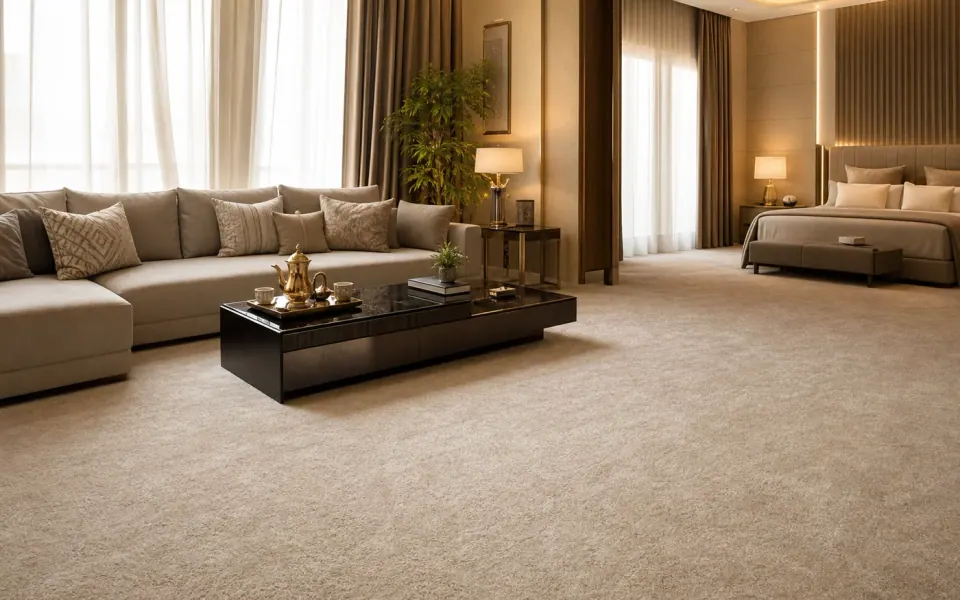
| Majlis and floor seating | Comfort for long sittings and resisting compression | A higher density so it does not flatten fast |
| Living room and corridor | Medium to heavy traffic | A firm layer that tolerates walking |
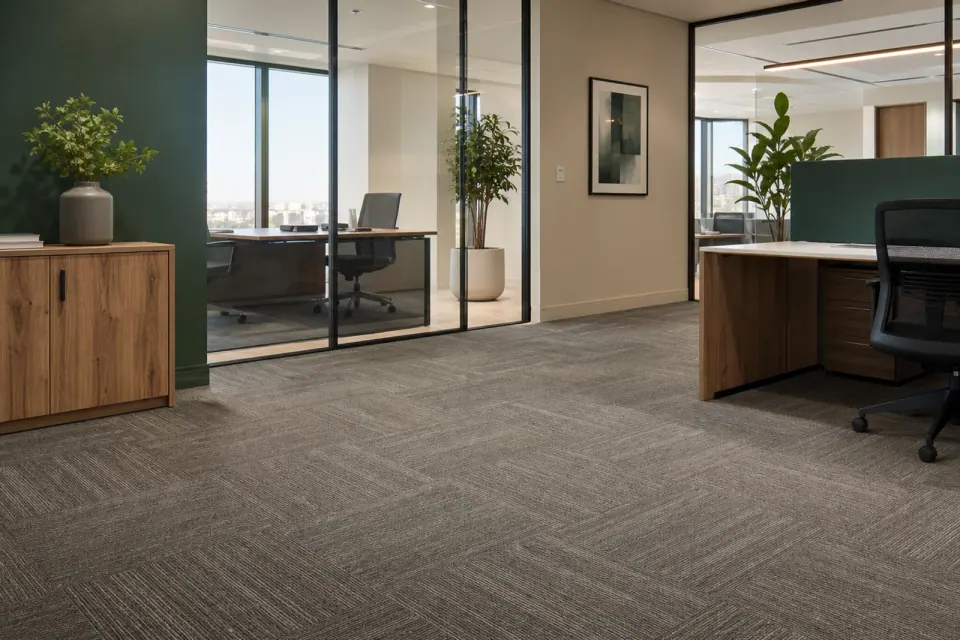
| Office or shop | Stability and levelness; direct glue-down may suit | Often none, or a special type for offices |
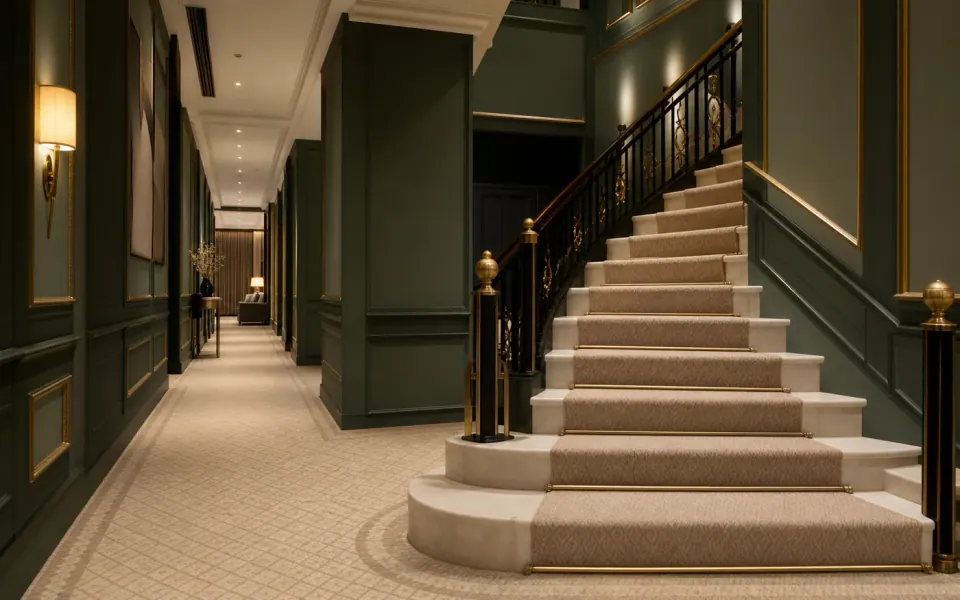
| Stairs | Firm fixing and safety | A thin, firm layer and tight fixing |
On WhatsApp send a photo of the space, the sizes and your preferred carpet, and we will arrange a free visit inside Riyadh.
The benefit varies from place to place. These are where customers notice the difference most.
The first thing a foot touches in the morning, so a soft layer gives warmth and softness.
Long sittings on the floor benefit from a layer of good density. See Arabic majlis flooring.
It softens the transfer of footstep noise to neighbours to a reasonable degree.
It adds softness to floor play, and colours that hide marks suit it. See children’s room flooring.
In quiet management rooms it reduces echo, though not every type suits wheeled chairs.
It helps keep the room calm but needs a type that tolerates office chairs. See meeting room carpet.
Enter the room length and width to see the area with a suggested waste allowance, then send the result on WhatsApp.
We confirm cleanliness, dryness and levelness before laying.
We unroll it and fix it with strips or tape depending on the method.
We trim at the edges and tape the joins so nothing moves.
We stretch the carpet over the underlay and fix it on the edge strips.
We treat edges and thresholds and hand over after inspection.
A low-density layer compresses quickly, so the carpet ripples and its life shortens.
A layer that is too thick lets the carpet move and crack at joins and makes it hard to stretch. Each product has a suitable thickness.
A layer can trap moisture if the floor is damp, so we advise testing it. See subfloor moisture test.
In busy offices and under trolleys, direct glue-down may be better, and the method differs by space.
We do not quote prices before the visit, but these factors decide the difference between one layer and another.
Foam, rubber, fibre or others, each with its own price.
The thicker it is, the more material it uses and the higher the price.
Higher density costs more but keeps its shape longer.
Counted with the carpet by square metre with a small waste allowance.
Strips, glue or tape, depending on the product and place.
Preparing the floor may add work before the layer is laid.
The carpet and its underlay work as one system, and caring for one protects the other.
It stops dust building up and working down to damage the layer and the carpet. See the carpet cleaning guide.
Flooding during cleaning can reach the underlay and cause smells, so we prefer professional cleaning with a suitable amount of water.
Heavy furniture compresses the layer where it stands and leaves a mark, so move it now and then and use wide bases.
If low spots or ripples appear the layer may have compressed, and we assess the condition and suggest a repair. See repair or replace carpet.
Not always. In homes it usually helps comfort and insulation, but in offices and shops with direct glue-down it may not be used, or a special type is used.
It depends on the carpet, the product and the maker’s recommendation. Too much thickness can harm the fixing, so we decide the right one after the visit.
It may compress quickly if its density is low, which shortens life and causes ripples. We compare the options with you by use.
It softens footstep noise and echo to a reasonable degree but it is not complete insulation. See the soundproof carpet page for more.
On stairs we use a thin, firm layer with tight fixing so the carpet does not move. See the stair carpet page.
In some cases yes if the carpet is fixed on strips, but it needs lifting and re-stretching, and we assess that on the visit.
Call or message us on WhatsApp with a photo of the room, the sizes and the carpet type. We arrange a free visit inside Riyadh and then send the quote.
Call or message us on WhatsApp with photos of the room and the sizes and we will arrange a visit inside Riyadh.
For loose rugs.
How to compare types.
Nylon, polyester and polypropylene.
In dry climates.
What decides the price.
A comparison to choose.
Causes and what to do.
Stretch-in or glue-down.
How to prevent and reduce them.
How to read pile weight, density and height in quotes.
Carpet, parquet and vinyl for dressing rooms and closets.