
Rented apartment
SPC over the existing tiles: quick, clean and removable. Pay for a decent underlay for the flat below.
All three are sold as “vinyl”, yet they differ in core, feel, fitting and what they demand of the floor beneath. Here is an honest room-by-room comparison; then we inspect your subfloor free anywhere in Riyadh.


SPC stands for stone plastic composite: a rigid, non-flexing core of limestone powder and PVC, topped with a print film and wear layer, usually with underlay pre-attached. It floats, clicking together without glue.
LVT — luxury vinyl tile — began as a name for any vinyl plank or tile imitating wood or stone. In the trade it now mostly means the thin, flexible product glued down across its whole surface, though flexible click versions exist.
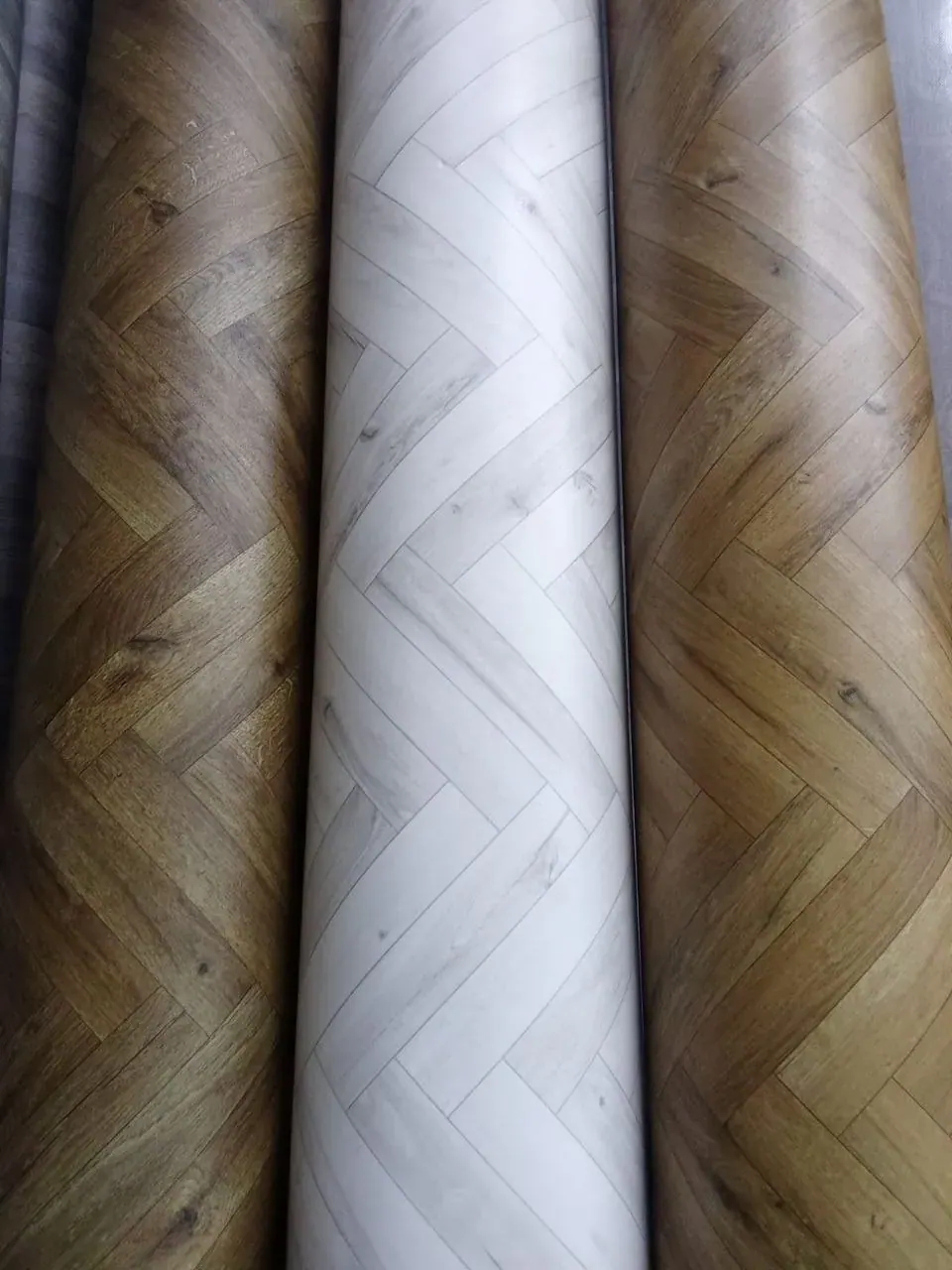
Sheet vinyl comes in wide rolls laid in one piece or with very few joins, fully adhered, with a foam backing for homes or a compact backing for commercial work. See our sheet vinyl page.
SPC feels firm, much like timber, but on a thin underlay it can sound hollow — the neighbours below will notice. Glued LVT is quieter, with no air gap beneath, and slightly warmer. Foam-backed sheet is softest of all, but dents most easily under heavy furniture legs.
The mineral core makes SPC the least prone to expansion, so it copes best beside sun-facing glass — provided the perimeter gap is right. Flexible LVT relies entirely on its bond; where adhesive weakens in a hot patch, gaps or lifted edges can appear. Glued sheet needs the same care with adhesive choice and shading.
SPC’s rigidity bridges grout lines and gentle undulations, but not real dips: the plank flexes over the hollow and the click joints can break. LVT and sheet telegraph almost everything beneath them, so they need a skimmed, spotless subfloor. That is why SPC is usually quickest over sound existing tiles.
A damaged glue-down LVT plank can be cut out and replaced on its own fairly easily. Replacing an SPC plank mid-room means unclicking rows from the nearest wall or a special cut-in. Sheet is patched with a pattern-matched piece, which shows more on plain colours. For tenants, SPC lifts out on moving day with no adhesive residue.
If water pools or the floor is disinfected constantly, start with welded sheet.
Sound tiles with slight unevenness lean SPC; a ready, skimmed screed opens the door to LVT.
Trolleys and castor chairs all day: glue-down. Feet and home furniture: SPC is fine.
Tenants and short-term owners benefit from a floating floor that lifts easily.
| SPC click | Glue-down LVT | Sheet vinyl | |
|---|---|---|---|
| Footstep noise in flats | Depends on underlay | Quiet | Quiet with foam backing |
| Stability by sunny glazing | Usually best | Good with the right adhesive | Good with the right adhesive |
| Castor chairs and trolleys | Fine for home use | Excellent | Excellent in commercial grades |
| Fixed kitchen island or units | Don’t fix on top | Suitable | Suitable with leg protection |
| Usable after fitting | Almost immediately | Once adhesive cures | Once adhesive cures |
| Replacing a damaged area | Possible, with effort | Easiest | Patch repair |
| Lifting when you move | Easy, no glue | Difficult | Difficult |
| Height at doorways | Highest of the three | Lowest | Low |
We never recommend a type before checking the floor — all three come with us to the free inspection.
SPC over the existing tiles: quick, clean and removable. Pay for a decent underlay for the flat below.
SPC with a correct expansion gap and shaded windows; we’d avoid flexible LVT in hours of direct sun.
Glue-down LVT or commercial sheet; a floating floor dislikes heavy rolling loads all day.
Heat-welded sheet with coved edges — plank joints are entry points for water. See waterproof flooring.
Foam-backed sheet or glued LVT for quietness, in a matt finish. SPC works, but is harder to land on.
SPC if you want one continuous floor — seal edges at the units and never fix the island onto it.
“100% waterproof.” The plank won’t absorb water, but water still finds its way through joints and edges. Real water resistance comes from the installation.
“8 mm thick.” That may include the attached underlay. What matters is the wear layer, often quoted in mil: 1 mil = 0.0254 mm, so 12 mil is roughly 0.3 mm and 20 mil roughly 0.5 mm.
Names used loosely. Some sellers call every click plank LVT, others every rigid vinyl SPC — and WPC, with a lighter foamed core, is different again. Read the core type on the data sheet yourself.

For most apartments we lean towards SPC: it goes over existing tiles quickly, copes with sunny windows and lifts out when you move. If the subfloor is already flat and quiet matters most, or castor chairs abound, glue-down LVT is strong. Seeing the floor settles it.
Neither absorbs water through its surface or core; the difference is the joints. Tightly bonded LVT leaves no void beneath, while floating SPC can let standing water creep past its edges to the subfloor. Where water genuinely sits, welded sheet vinyl is safer than either.
Yes, if the tiles are firmly bonded and the grout lines are filled or the surface skimmed, since thin LVT shows what is underneath over time. Glossy glaze and grease must be cleaned off so the adhesive grips. SPC is more tolerant of grout lines and needs no glue at all.
Usually a thin underlay or an uneven subfloor leaving a small void under the plank, so it taps as you walk. Furniture pressed against the skirting or a blocked expansion gap can also cause it. The fix starts before fitting — levelling dips and choosing the right underlay, which we check at the inspection.
WPC is a click plank with a foamed PVC-composite core, so it is lighter, warmer and a little softer underfoot than SPC. SPC’s mineral core is denser and steadier under load and heat. Each has its place; what matters is knowing which core you are buying, not just a trade name.
Ask for the data sheet: core type, wear layer listed separately from total thickness, and approved fitting method. Then flex the sample — SPC won’t bend, flexible LVT does. On inspections in Riyadh we bring all three so you can compare.


WhatsApp a photo of your floor and the room sizes; we’ll bring all three samples to a free inspection and recommend one after checking the subfloor. More in our flooring guides.
Choosing the right vinyl specification
How to clean vinyl flooring and keep it looking good: daily care, stain removal, safe…
Clean, anti-slip vinyl for stores
What decides how long vinyl flooring lasts in Riyadh homes and offices: wear layer, core, heat, subfloor prep and cleaning. Free inspection and a…