

Majlis and entrances
A large rug on top leaves a timber frame showing — see our majlis rugs.
A herringbone floor isn’t a colour you pick from a catalogue; it is a design drawn onto your room before a single board goes down. This page takes our parquet flooring in Riyadh guide deeper into zigzag patterns, and our free visit is where we fix the centre line and direction.


Herringbone and chevron boards are shorter than standard planks and come in two mirror-image types, often labelled A and B, because the click tongue sits on opposite sides. Alternating them creates the zigzag — so you can’t make the pattern by cutting up ordinary straight boards.
Chevron ends are cut at an angle that varies between collections — some close to 45 degrees, others sharper or flatter — and each gives a different arrowhead. Board width and length set the scale: small boards read as a fine, classic texture, while long, wide ones make a bold statement suited to large lounges.

| Herringbone | Chevron | Straight | |
|---|---|---|---|
| Board ends | Square | Angle-cut | Square |
| Overall feel | Broken, warm movement | Sharp, continuous lines | Calm and simple |
| Typical waste | Higher than straight | Usually higher than straight | Lowest |
| Fitting time | Longer | Longer | Fastest |
| Sensitivity to subfloor flatness | High | High | Moderate |
| Where it shines | Majlis rooms, libraries, bedrooms | Entrances, hallways, formal lounges | Almost anywhere |
On a tighter budget? Laminate flooring also comes in zigzag formats.
With herringbone, a small error at the start multiplies across the room, leaving the pattern skewed at the far wall or with uneven slivers at the door. So three decisions come before laying.
The usual rule is to run the pattern’s axis along the length of the room, or towards the main door or largest window, drawing the eye into the space. In a long majlis — the formal reception room of a Saudi home — it typically runs from the entrance to the head of the room.
We snap a reference line through the middle of the room, or through a focal point such as the majlis entrance, then balance the boards either side so the cut pieces match at both walls. Walls in real homes aren’t always parallel, so we measure the width in several places before committing.
A border is one or two rows of straight boards framing the pattern along the walls. It hides walls that aren’t quite straight, avoids fiddly small cuts and makes the floor look like a framed timber rug, at the cost of extra time and boards.
Where rooms connect, we decide together whether the pattern flows through as one floor or each room starts afresh with a threshold strip. Flowing suits open-plan spaces; separating is more practical when rooms run in different directions.
A large rug on top leaves a timber frame showing — see our majlis rugs.

Pale tones and smaller boards feel calm and never crowd the room.

A polished first impression in receptions and small showrooms, in a commercial wear class.
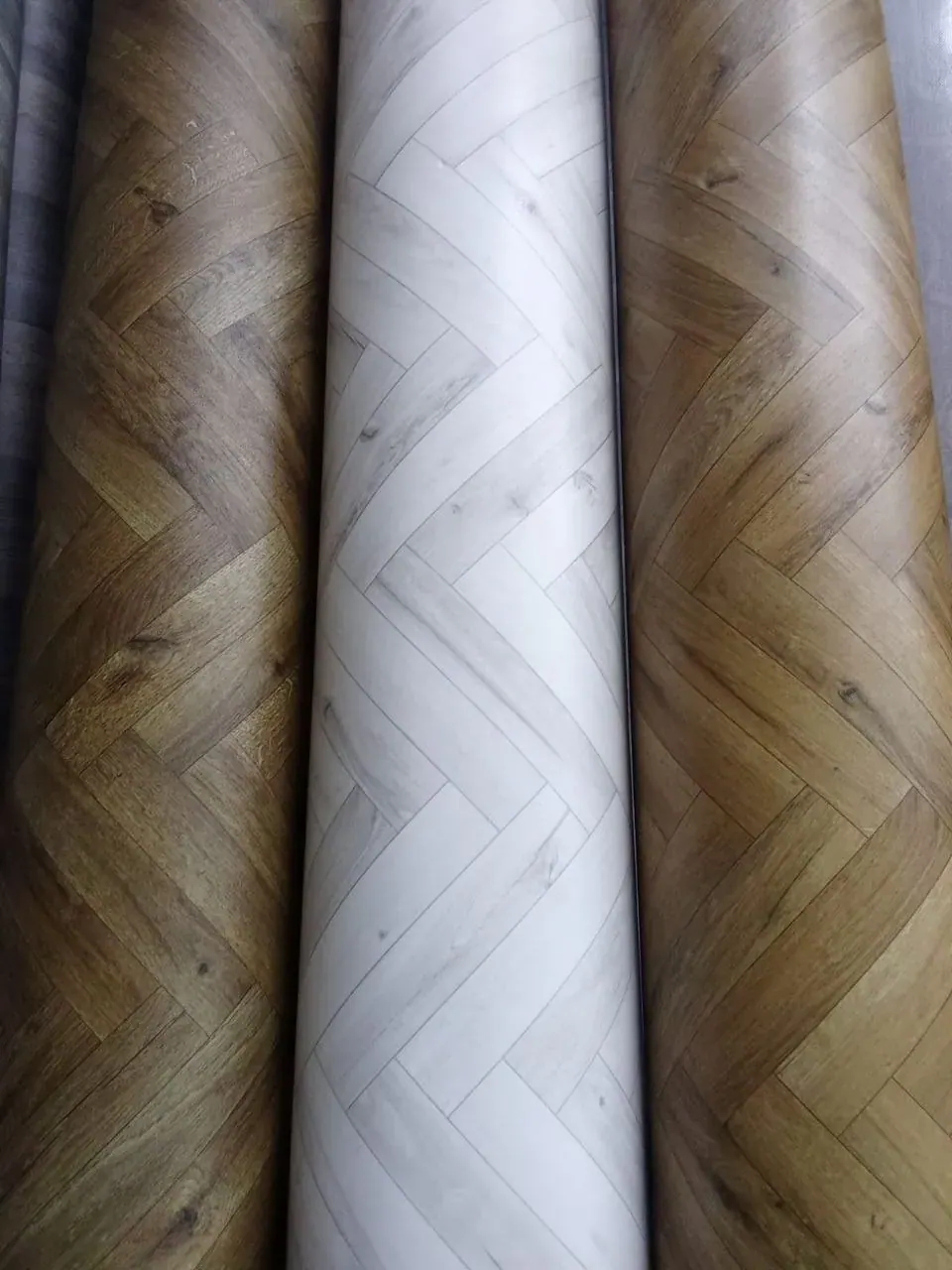
Kitchens and laundries can carry the same look in water-tolerant sheet vinyl.
No generic figures here — just the factors that help you compare quotes fairly. More in our parquet price guide.
Every row ends in an angled cut at the wall, so you buy more than the room’s floor area.
Short boards mean more joints per metre, and every edge piece is measured and cut individually, so each metre takes longer.
Mirror-image boards with precisely finished ends are often priced above comparable straight planks.
The pattern exposes any undulation, so more levelling may be needed, and a border adds boards and time.
Send room photos and rough sizes on WhatsApp for an initial pattern suggestion.
We measure the width at several points, check flatness and lay samples in the room’s real light.
We agree the axis, centre line, border and doorway transitions, then calculate quantity including waste.
Low spots are levelled, then boards go down from the centre line out to both walls with an expansion gap. General steps are on our parquet installation page.
Border, skirting and profiles go in, then we clean up and hand over with care advice.
Enter room dimensions and choose higher waste than usual for zigzag patterns — more for irregular rooms. We check the figure once the plan is drawn.
Yes, but board size matters. Small boards in a calm tone turn the pattern into a fine texture that doesn’t feel busy, whereas wide boards in a small room leave lots of cut pieces at the walls. A lengthwise axis helps too.
Herringbone sits more naturally with classic décor and traditional floor seating, while chevron suits modern majlis rooms with crisp lines and concealed lighting. Either way, the seating area is usually covered by a rug, so the pattern shows as a frame around it — something we factor in when setting the axis.
Often, yes, if the tiles are solid and very flat. The pattern is more sensitive to undulation than straight planks because its many short joints reveal every difference, so we check flatness with a long straightedge and may level some areas first.
Typically more than with straight planks, because every row ends in an angled cut at the wall. It rises further in rooms with corners, columns or narrow passages, and drops somewhat with a straight border. We calculate the real figure from the plan; keep a spare box.
Yes, if the two spaces share a similar axis, so the floor reads as one. If the hallway runs very differently, a threshold strip and a fresh start along the hallway’s axis usually looks better. We show you both options on the plan before work starts.
Mid tones with visible grain bring the pattern out most, because light catches each board at a different angle. Very pale shades make it soft and subtle; dark ones look luxurious but show dust. Check samples in daylight and evening light.
Much like any parquet, but more joints mean more places for water to get in, so use a well-wrung mop and never pour water on the floor. Fit felt pads under sofas and chairs, and put rugs on heavy walkways so one part of the pattern doesn’t fade faster than the rest.


Send a simple sketch of the room with door and window positions on WhatsApp, or book a free visit in Riyadh to set the axis, centre line and samples. Villa owners in the north can also see our Hittin flooring page.
A floor built for daily life
Understanding parquet specifications and origin
Types, sizes, installation and care for German parquet.
Covering stairs with parquet: steps and considerations.
Choosing oak, walnut or grey
What an expansion gap is for parquet, laminate and floating vinyl and why it matters in Riyadh heat: where it goes, how skirting hides it, and common…