
Angled end cuts
Each plank end is cut at an angle set by the manufacturer, so it meets its neighbour in an unbroken line instead of a square end. That cut is the whole basis of the pattern.
Chevron parquet uses planks cut at an angle so their ends meet in continuous V lines that run the length of the room. We supply and fit chevron parquet in Riyadh, and help you choose the material, colour and laying direction before you buy, after an inspection and measurement at your property.
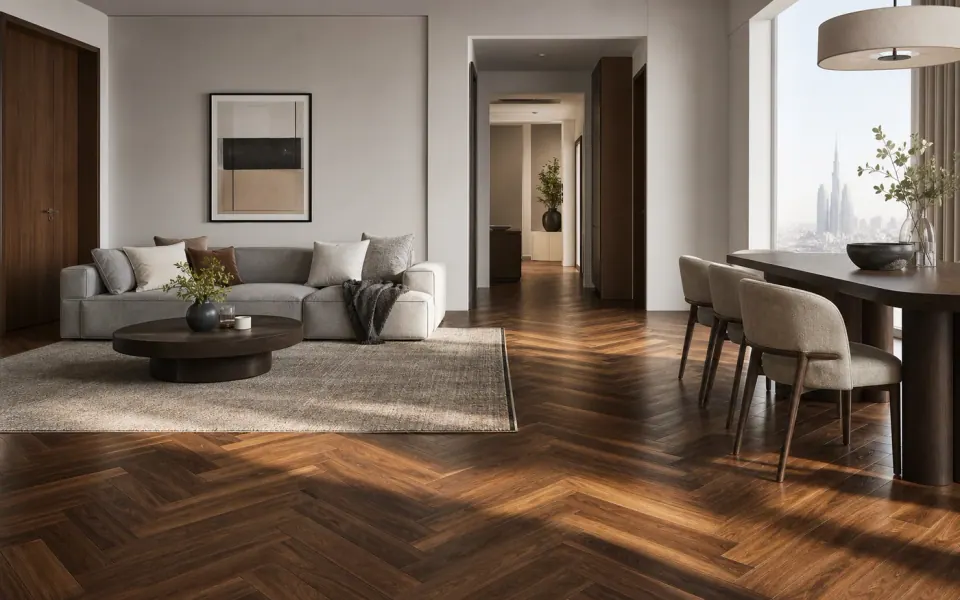

Before settling on a pattern from the wider parquet range, it helps to understand how chevron is made and what sets it apart in looks, fitting and cost.
Each plank end is cut at an angle set by the manufacturer, so it meets its neighbour in an unbroken line instead of a square end. That cut is the whole basis of the pattern.
Laid side by side, the planks form a series of arrowheads across the entire floor. It gives a room a sense of movement and direction that straight planks do not.
Herringbone uses rectangular planks whose ends rest against the side of the next plank, giving a staggered zigzag. Chevron lines are sharp and continuous. See herringbone parquet in Riyadh for that pattern.
Ready-made chevron usually comes in two plank types, one cut to the left and one to the right, laid in alternation. Mixing them up or turning them the wrong way breaks the pattern along the whole row.
The direction the Vs point relative to the door and window changes how the room feels and how long it looks. We settle it with you at the inspection, based on where light enters and the longest run of the space.
The pattern is bold by nature, so it suits living rooms and open spaces better than small rooms crowded with furniture and busy prints. We talk this through before you commit.
Chevron comes in more than one material, and each behaves differently with heat, humidity and daily wear. We show you the samples we can supply during the inspection and explain the practical differences rather than leaving you with product photos alone.
The most common choice in apartments and villas because it uses a click-lock system and copes with normal home use. For the differences between wear grades and thicknesses, read the HDF parquet guide and the laminate parquet page.
A layer of real wood over a multi-layer core, so it moves less than solid wood. It gives the look of genuine timber and generally costs more. A detailed comparison is in solid vs engineered parquet.
Chosen when you want a floor that can be sanded and refinished over the long term. It is more sensitive to changes in humidity, and we do not recommend it before the subfloor is checked and the air-conditioning conditions of the space are understood.
Light and oak tones open up a room and soften the pattern, while dark tones make the V lines dramatic but show dust and scratches more clearly. Plank size also affects how dense the pattern looks: shorter planks give smaller, busier Vs.
The right base is a level tile floor or dry, level concrete, and we may correct flatness problems before laying. Preparation details are in floor preparation and levelling and parquet installation.
Large spaces let the V lines run on without the pattern feeling crowded. The laying direction is best set along the length of the room or toward the main light source.

A warm floor gives a hotel-style feel. We suggest a rug beside the bed to soften echo and protect the planks from daily rubbing.

It gives reception areas a refined first impression. Pay attention to office-chair routes and protect the floor with suitable pads under furniture.
We measure the room, check flatness and moisture, and note door positions that affect the V direction.
We mark the start line at the centre of the room or along the main wall so the symmetry reads clearly at the entrance.
We lay the first rows without fixing to confirm the A and B planks match and the angles meet properly before going on.
We continue the rows leaving an expansion gap, and cut the edges at walls and columns at precise angles.
We fit skirting and threshold profiles, clean the site and hand over the floor with care instructions.
| Pattern | Look | Fitting notes |
|---|---|---|
| Chevron | Sharp, continuous V lines | Angle-cut planks that need high precision and more waste |
| Herringbone | Staggered zigzag from rectangular planks | Cutting mostly at the walls, and a calmer look than chevron |
| Straight laying | Parallel planks with quiet lines | Fastest and lowest waste, suited to small rooms and tighter budgets |
Many chevron mistakes start with laying from a random wall. If you begin from a wall that is not square to the room, the offset builds up and the pattern drifts at the opposite side. So we measure first and snap a fixed start line that every row is built from.
Direction also changes how the space feels: Vs pointing toward the far wall make a room look longer, while Vs pointing toward the window catch the light and bring out the colour of the wood. We show you both options on a sketch before work starts.

HDF, engineered or solid wood, plus plank thickness and surface wear layer, all change the price noticeably.
Chevron needs angled cuts at the edges, so the quantity ordered is higher than for straight laying. We work it out with you accurately.
Levelling or moisture treatment before laying is separate work from the parquet price, and we define it at the inspection.
Underlay, skirting, profiles and door trimming are priced by site. We send a clear quote after the inspection, and the general factors are in parquet prices in Riyadh.
Enter the room length and width to get the area and a suggested order with a waste allowance. Chevron needs more waste than straight laying, so choose 15% if the room has many corners.
Chevron planks are cut at an angle so their ends form sharp, continuous V lines, while herringbone uses rectangular planks and looks like a staggered zigzag with interlocking ends. Chevron is sharper and more demanding to fit; herringbone is calmer and easier to cut. We show both samples side by side at the inspection.
The total cost is usually higher because waste is greater and fitting is slower and needs precise cutting. The gap varies with material and plank size, so we do not quote a general figure and give a price based on your room measurements after the inspection.
It can be used, but the bold pattern may feel busy in a small room with a lot of furniture. In that case we suggest longer planks, calm light colours, or using chevron in the living room and straight laying in side rooms.
In most cases yes, if the tiles are firm, level and free of moisture, with a suitable underlay. We check flatness with a straightedge and measure the height difference at doors before deciding. More in floor preparation and levelling.
There is no single rule. We choose it from the length of the room, the light source and the position of the main door, and show it on a sketch before fitting. The aim is symmetry at the entrance and no thin cut pieces at the walls.
Clean with a soft broom or a barely damp mop, avoid excess water, and put soft pads under furniture legs. Care and repair details are in parquet maintenance and repair.
Parquet generally expands and contracts with heat and humidity, so we leave an expansion gap at the walls and recommend steady air-conditioning in the room. Read expansion gaps and heat for the detail.
Chevron takes longer than straight laying because of precise cutting and alternating A and B planks, and the time depends on room size and subfloor condition. We give an estimated duration after the inspection, and you can read flooring installation duration.


Send room sizes and a photo of the current floor on WhatsApp, and we will arrange the inspection and a quote inside Riyadh.
Underlay types and when you need one before fitting parquet or vinyl.
How to choose skirting and threshold profiles for your floor.
Choosing materials for living rooms, majlis and master rooms.
How colour affects light, dust and the feel of space.
A frank look before you decide.
Daily care and treating scratches and swelling.