Painting and filler
Paint or filler dropping on the floor leaves marks that are hard to remove once dry. Use a cover that handles liquid and does not stick.
A new floor is most at risk in the last days of fit-out: painting, lighting, air conditioning and moving furniture. We explain how to protect it with suitable materials and a sensible order of trades, and agree an installation date that lands at the right moment.


Most damage happens right after installation and before handover, and it comes from what happens on top of the floor rather than the floor itself. See flooring project steps to see where protection fits in the sequence.
Paint or filler dropping on the floor leaves marks that are hard to remove once dry. Use a cover that handles liquid and does not stick.
Ladder and scaffold feet scratch and dent floors. Put protective pads or felts under them.
Dragging heavy furniture or kitchen units scratches the surface. Lift and carry; do not drag.
Sand and grit under shoes act like sandpaper. Keep dirty shoes out or lay entrance mats.
Tools, screws and metal off-cuts can drop and scratch or chip a sensitive surface.
Direct sunlight may change the colour of some floors. See sunlight and floor fading.
No single material suits every floor, and the most common mistake is sticking strong tape straight onto a sensitive surface. Ask your supplier what suits your floor type before work begins.
It needs a cover that lets some air through and does not trap moisture for long. Avoid strong tape directly on the face. See parquet installation.
Thick paper, rigid cardboard or light protection boards usually suit it, noting that some tapes leave marks. See vinyl installation.
Cover areas with suitable cloth or plastic and protect walkways with mats. Keep liquids away. See carpet installation.
Protect edges at doors and profiles with extra pieces, because they take the first abrasion.
We lay at a time that limits exposure to the remaining trades.
This is when protection starts, before other teams come in.
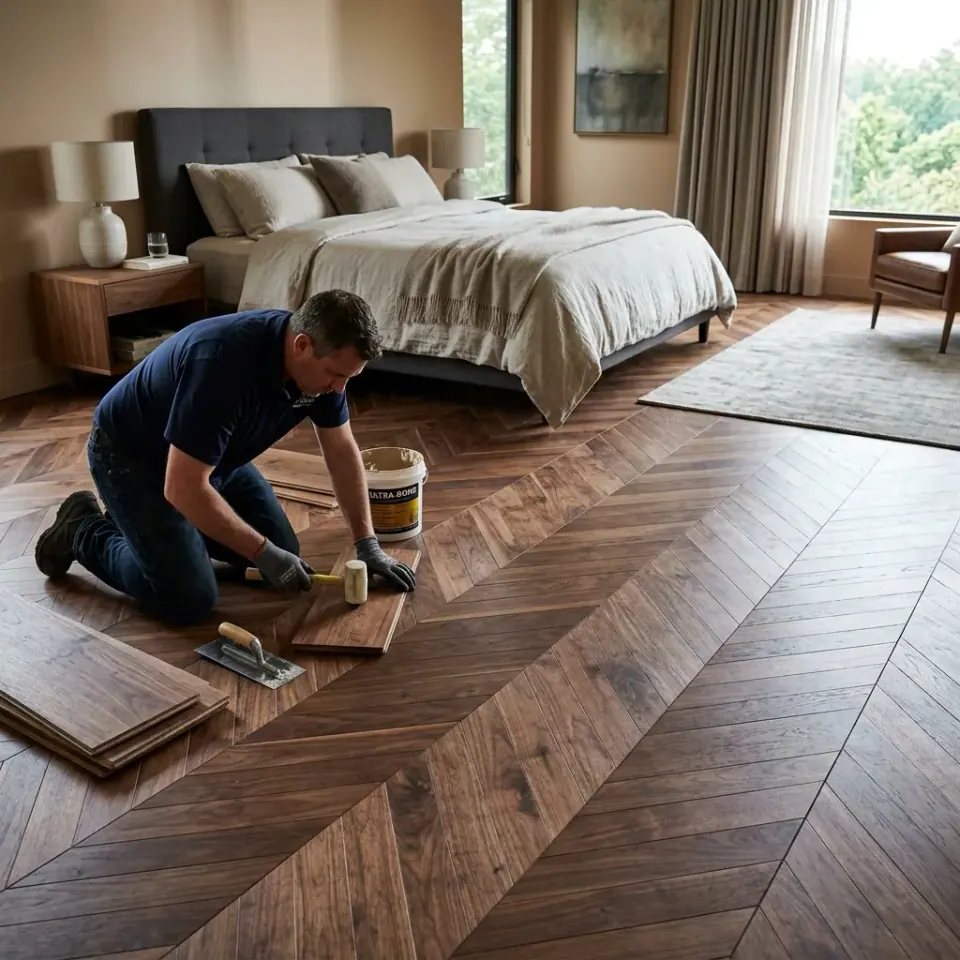
The room is finished, closed and protected before other work continues.
Send us the project stage and the floor type and we will reply with a suggested sequence.
Blockwork, plaster, waterproofing and plumbing finish and dry before any floor.
Ideally finish ceilings and main painting before laying, or protect very well.
Install after the base is dry and levelness and moisture are checked.
Cover the floor straight away and protect edges and entrances.
Furniture, small lighting and final cleaning, then handover.
| Protection | Note | |
|---|---|---|
| Painters | Full cover with gently fixed edges | Finish painting before laying if possible. |
| AC and electrical trades | Boards or mats on walkways | No dropping sharp metal. |
| Moving kitchens and furniture | Lift, do not drag, with felt pads | Done once the floor is confirmed dry. |
| Workers generally | Shoe mat at the entrance | Cuts down sand and grit. |
To coordinate with your project contractor see flooring supply for contractors.
Most damage we see at handover is avoidable with a little coordination before installation starts.
A floor over concrete or plaster that has not dried suffers from moisture, especially wood. See subfloor moisture testing.
It may mark some surfaces or lift the finish. Use suitable protection.
Any exposed floor meets shoes and tools. Cover it as soon as it is laid.
Tell painters and technicians the floor type and protection method; they are the first to work over it.
Inspecting at handover shows any defect. Use the handover checklist.
When all work is done, covers are lifted carefully and the surface cleaned in the right way, then checked by eye under good light. Any scratch, gap or raised edge is recorded and corrected before handover. For cleaning and care afterwards see vinyl cleaning or parquet maintenance depending on your floor.
We are happy to coordinate with your project manager or contractor to set the best date for each floor, because good timing saves a lot of rework.
Place the floor after the messy trades and before the ones that bring heavy traffic.
State in the contract who is responsible for protecting the floor after installation.
They cut the sand and dust coming into the building.
Inspect the floor after each stage to catch damage early.
After wet trades and ideally main painting, with a plan to protect it through whatever work remains.
Avoid strong tape directly on the face. Use a suitable cover and ask your supplier.
Thick paper or rigid cardboard, noting the tape used to fix it. We explain what suits your floor at the visit.
Lift rather than drag, and put felt pads or protection pieces underneath.
Yes, but it needs strong cover. That is why we prefer painting first when the schedule allows.
The contract between owner and contractor decides. We recommend stating it in writing.
Send the project stage on WhatsApp or call us for a suggested date, and see how long installation takes.
Send the project stage and we will reply with a suggested date.
Felt pads and moving methods.
Protecting colour.
How long each type takes.
Renewal options.
For larger projects.
Free site visit.
Vinyl rolls and carpet tiles for contractors’ site offices, fitted fast.
Parquet, vinyl and rugs for developers’ galleries, fitted to schedule.
A phased work plan without moving out.
Basement and ground-floor flooring in Riyadh: handling moisture first, then choosing SPC vinyl or other options after checking…